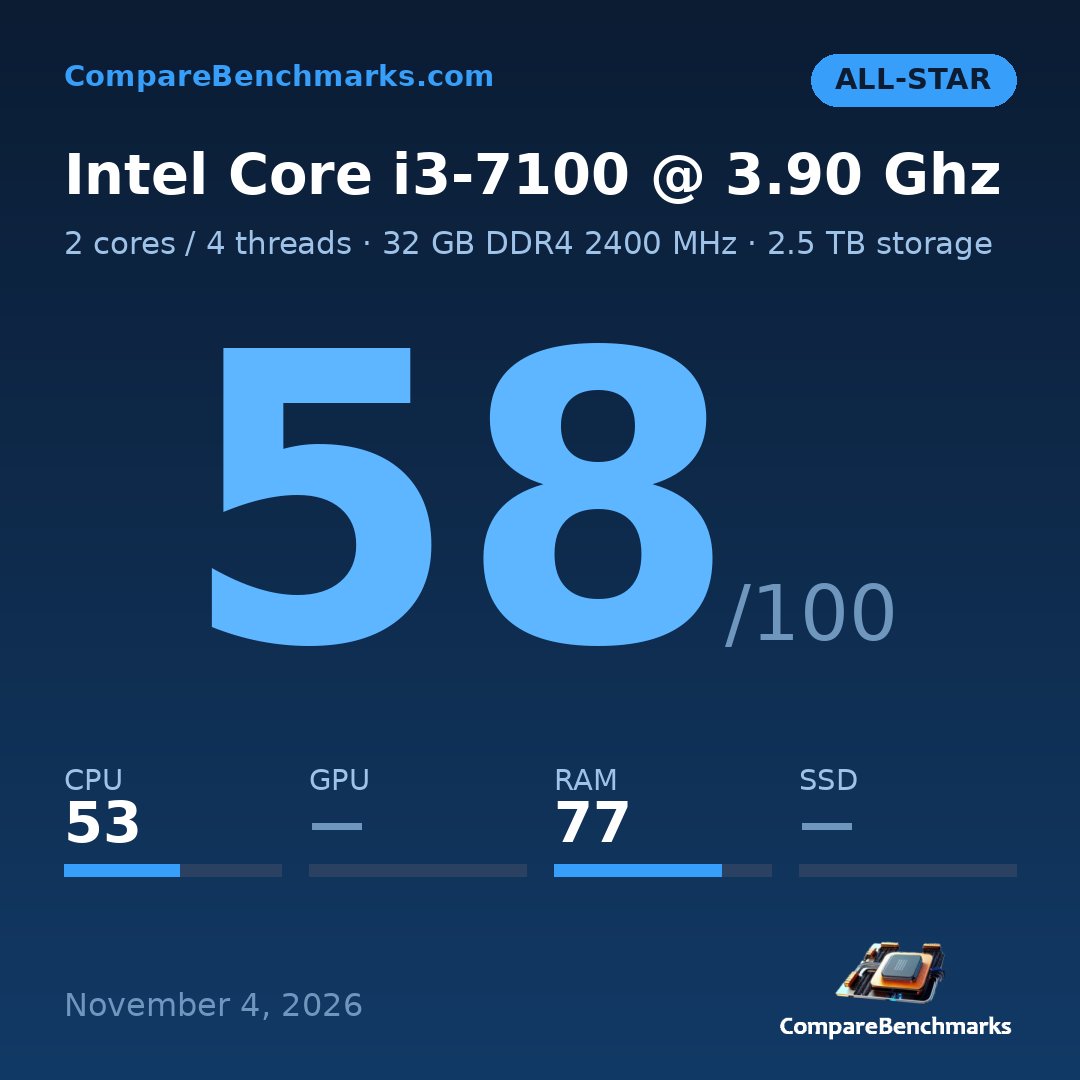
Intel Core i3-7100 @ 3.90 Ghz with Intel HD Graphics 630
Benchmark run November 4, 2026 UTC · Report #6656320510206252739
System Overview
This benchmark report provides a detailed overview of the hardware components of the PC system with Intel Core i3-7100 @ 3.90 Ghz including the CPU, GPU, RAM, and SSD. The benchmark results help assess the system’s overall performance and identify potential areas for upgrade.
| CPU | Intel Core i3-7100 @ 3.90 Ghz |
| GPU | Intel HD Graphics 630 |
| SSD | Samsung SSD 850 EVO 250GB |
| RAM | CRUCIAL DDR4-2400 32 GB |
|
Score
An aggregated score representing the total performance of the entire system, including the CPU, GPU, RAM, SSD. Useful for evaluating general system performance and comparing complete systems.
| 58 |
CPU
The CPU (Central Processing Unit) is the primary component responsible for executing instructions and processing data in your computer. This section provides detailed benchmark results for both single-core and multi-core performance, which are crucial for understanding how well your processor handles tasks that require high speed and parallel processing. The benchmarks include various computational tests such as encryption, arithmetic, and compression to evaluate the CPU's capabilities under different workloads.
| CPU Model | Intel Core i3-7100 @ 3.90 Ghz |
| CPU Address Width | 64-bit |
| Socket | LGA1151 |
| Cores | 2 |
| Logical Cores | 4 |
| Base Clock Speed | 3.90 Ghz |
| L1 Cache Size | 128 KB |
| L2 Cache Size | 512 KB |
| L3 Cache Size | 3072 KB |
Multi-Core Benchmarks
|
AES 256 Decryption
Measures the speed at which the CPU can decrypt data using AES-256 across multiple threads. This indicates the processor's ability to handle parallel cryptographic workloads.
|
8,276 MB/s
|
|
AES 256 Encryption
Measures the speed at which the CPU can encrypt data using AES-256 across multiple threads. Essential for secure data transmission and storage in multi-threaded applications.
|
3,892 MB/s
|
|
Floating Arithmetic
Evaluates the CPU's performance in floating-point arithmetic operations across multiple threads. Important for scientific computing, 3D rendering, and complex simulations.
|
24,476 MB/s
|
|
Integer Arithmetic
Measures the CPU's ability to perform integer arithmetic operations across multiple threads. Relevant for general computing tasks, data processing, and database operations.
|
11,207 MB/s
|
|
Matrix Multiplication
Assesses the CPU's performance in multiplying matrices using multiple threads. Critical for machine learning, data analysis, and high-performance computing applications.
|
1,491 MB/s
|
|
SHA 256 Hashing
Measures the speed at which the CPU can compute SHA-256 hashes across multiple threads. Important for blockchain, data integrity checks, and secure communications.
|
466 MB/s
|
|
ZIP Compression
Evaluates the CPU's performance in compressing data using the ZIP algorithm across multiple threads. Useful for archiving, data backup, and reducing file sizes efficiently.
|
44 MB/s
|
|
ZIP Decompression
Measures the CPU's speed in decompressing ZIP archives across multiple threads. Important for quickly accessing compressed data and software installations.
|
602 MB/s
|
|
Multi-Core Score
An aggregated score representing the overall performance of the CPU across all available cores. A higher score indicates superior performance in multi-threaded applications.
|
34
|
Single-Core Benchmarks
|
AES 256 Decryption
Measures the speed at which the CPU can decrypt data using AES-256 on a single thread. This reflects the raw single-core cryptographic performance.
|
4,202 MB/s
|
|
AES 256 Encryption
Measures the speed at which the CPU can encrypt data using AES-256 on a single thread. This benchmark is crucial for understanding single-core encryption capabilities.
|
996 MB/s
|
|
Floating Arithmetic
Evaluates the CPU's performance in floating-point arithmetic operations on a single thread. This is a key indicator for tasks that rely heavily on single-core floating-point calculations.
|
13,008 MB/s
|
|
Integer Arithmetic
Measures the CPU's ability to perform integer arithmetic operations on a single thread. This benchmark is fundamental for assessing basic computational speed.
|
5,600 MB/s
|
|
Matrix Multiplication
Assesses the CPU's performance in multiplying matrices on a single thread. This indicates efficiency in linear algebra operations for less parallelized tasks.
|
731 MB/s
|
|
SHA 256 Hashing
Measures the speed at which the CPU can compute SHA-256 hashes on a single thread. This reflects the single-core hashing capability, relevant for various security protocols.
|
246 MB/s
|
|
ZIP Compression
Evaluates the CPU's performance in compressing data using the ZIP algorithm on a single thread. This benchmark shows the single-core efficiency in file compression.
|
14 MB/s
|
|
ZIP Decompression
Measures the CPU's speed in decompressing ZIP archives on a single thread. This indicates the single-core performance for extracting compressed files.
|
219 MB/s
|
|
Single-Core Score
An aggregated score representing the performance of a single CPU core. A higher score indicates better performance in applications that are not heavily multi-threaded.
|
73
|
GPU
The GPU (Graphics Processing Unit) handles rendering images, videos, and animations on your display. This section presents benchmarks that measure the GPU's performance in tasks like vertex processing, pixel shading, and texture mapping. These results help determine how well your graphics card can handle gaming, video editing, and other graphics-intensive applications. The benchmarks also include memory transfer speeds to assess how quickly data moves between the GPU and system memory.
| GPU Model | Intel HD Graphics 630 |
| Type | Integrated |
| Dedicated Memory (VRAM) | / |
Benchmarks
SSD
The SSD (Solid State Drive) is your computer's primary storage device, holding the operating system, applications, and files. This section includes benchmarks for sequential and random read/write speeds, which are key indicators of how quickly your system can boot, launch applications, and transfer files. The results also show the SSD's input/output operations per second (IOPS) and latency, providing insight into its responsiveness under various workloads.
| Model | Samsung SSD 850 EVO 250GB |
| Size | 250 GB |
| Disk Type | SSD |
Benchmarks
RAM
RAM (Random Access Memory) is temporary storage that your computer uses to hold data that is actively being used. This section shows the read and write speeds of your RAM, which affect how quickly applications can load and process data. The benchmarks here help evaluate the efficiency of your memory modules and their impact on overall system responsiveness. Faster RAM speeds can significantly improve performance in memory-intensive tasks such as video editing and gaming.
| Name | CRUCIAL DDR4-2400 32 GB |
| Capacity | 32 GB |
| Type | DDR4 |
| Speed | 2400 MHz |
| Voltage | 1.200 V |
Benchmarks
|
Read Speed
Measures the sequential read speed of the RAM in gigabytes per second. Higher read speeds are beneficial for loading large files and applications quickly.
|
29.35 GB/s
|
|
Write Speed
Measures the sequential write speed of the RAM in gigabytes per second. Higher write speeds are important for saving large files and for applications that frequently write data to memory.
|
14.17 GB/s
|
|
RAM Score
A composite of the measured read and write bandwidth, each normalized against a reference machine and averaged. It is an ABSOLUTE measure — a machine with more memory channels or faster modules legitimately scores higher, so a server with eight channels beats a laptop even when both are running at their full potential.
|
77
|
Test Your Own System
Curious how your own PC stacks up? Download our free benchmark tool to get a detailed performance report for your system. See your scores, identify bottlenecks, and compare your results with other systems.
Download and Test Your PC